
Tourists in Bali who are planning on visiting any of the island’s leading monkey attractions are being reminded not to interact with the wild animals.
New signage is being introduced at Alas Pala Sangeh Monkey Forest to help remind tourists of the potential risks in engaging with the monkeys.
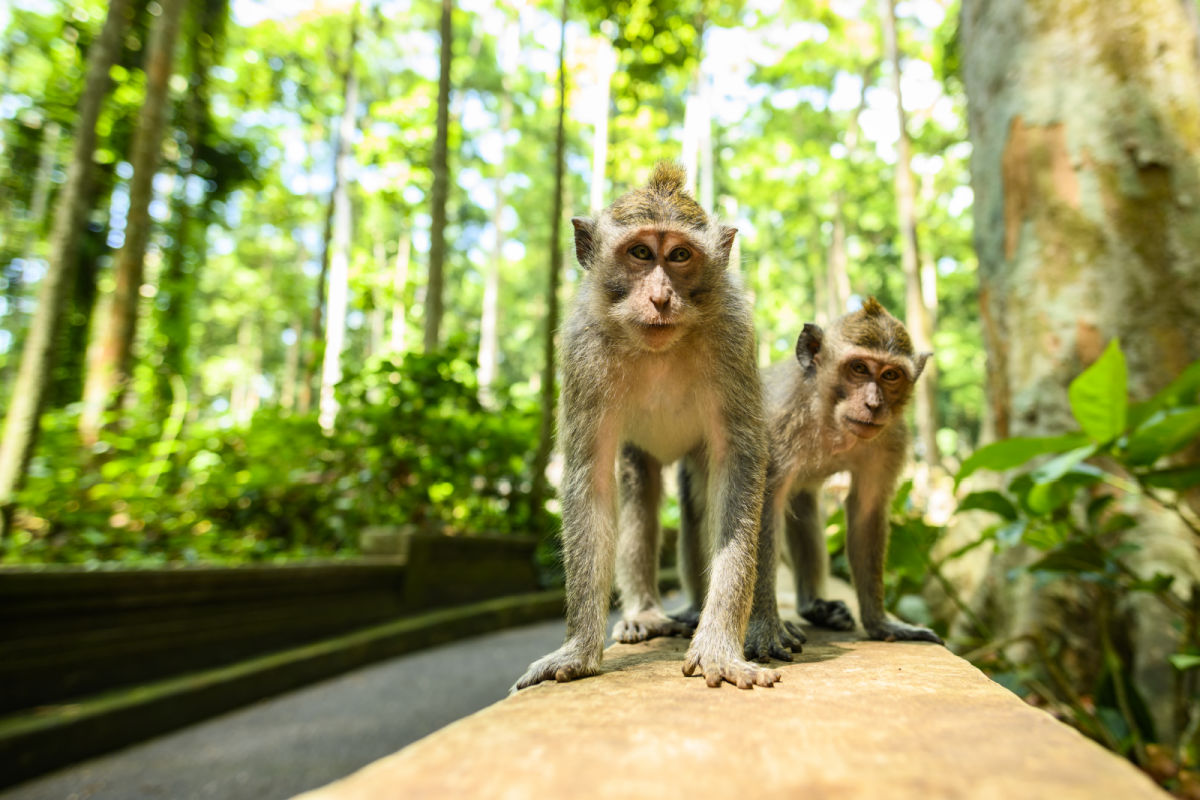

Alas Pala Sangeh Monkey Forest, often known simply as Sangeh Monkey Forest, has installed a series of new warning signs for both visitors and those moving around the forest area.
While there is a low border wall around most of the forest area, the monkeys are wild and can move in and out of the sanctuary area as they please, and they often do. This can cause potential conflict with local residents and drivers.
Tourism Managers from Alas Pala Sangeh Monkey Forest have installed green warning boards that read, clearly, ‘Please Don’t Touch the Monkeys, ‘ and below is added a warning in Indonesian, which translates more literally to ‘It is forbidden to touch the monkeys.’
This warning board stands facing the sidewalk and the highway in front of it.
The The Head of the Tourism Management at Alas Pala Sangeh Monkey Forest, IB Gede Pujawan said that along the east side of the forest where many of the long-tailed macaques are living is difficult to monitor. The forest spans over 14 hectares, and a number of different troops of monkeys reside across the forest area. The east side of the forest is directly adjacent to public roads, so it is difficult for the team to monitor if there are tourists stopping by without entering via the tourist gate.
Pujawan told reporters “The sign board is an anticipation of unwanted events because as we know monkeys are wild, anywhere in Sangeh, in Uluwatu, the animals are not allowed to be touched.”
Pujawan reiterated that every tourist who visits Sangeh Monkey Forest or any other landscape where wild monkeys are present, including when the monkeys enter residential areas, should never touch them or interact with them; only observe them from a safe distance.
He confirmed that all tourists who visit the Alas Pala Sangeh Monkey Forest are given a briefing by staff about the rules, but he noted that it is hard to communicate this to tourists who come across the Sangeh Monkey Forest resident monkeys outside the forest itself.
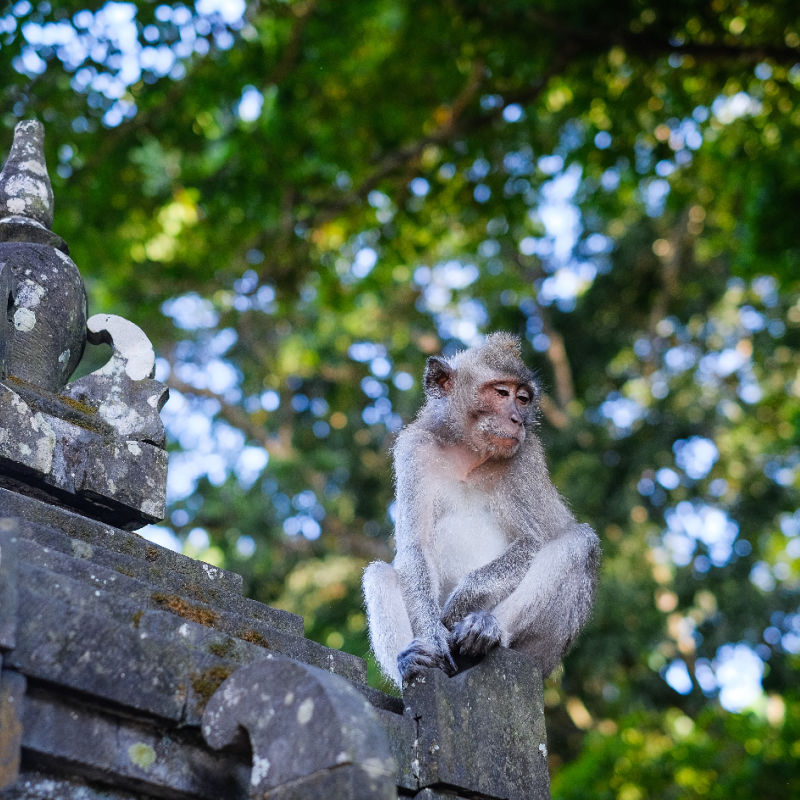
Pujawan noted that despite all efforts to maintain the safety of tourists during their visits to the attraction, there are always those tourists who break the rules when they are not supervised, or the tourists who choose to outrightly flout the rules and ignore the instructions of forest guards.
In light of this, Sangeh Monkey Forest has recorded more than 20 cases of tourist contact with this Rabies Infectious Animal (HPR) during January-September 2025.
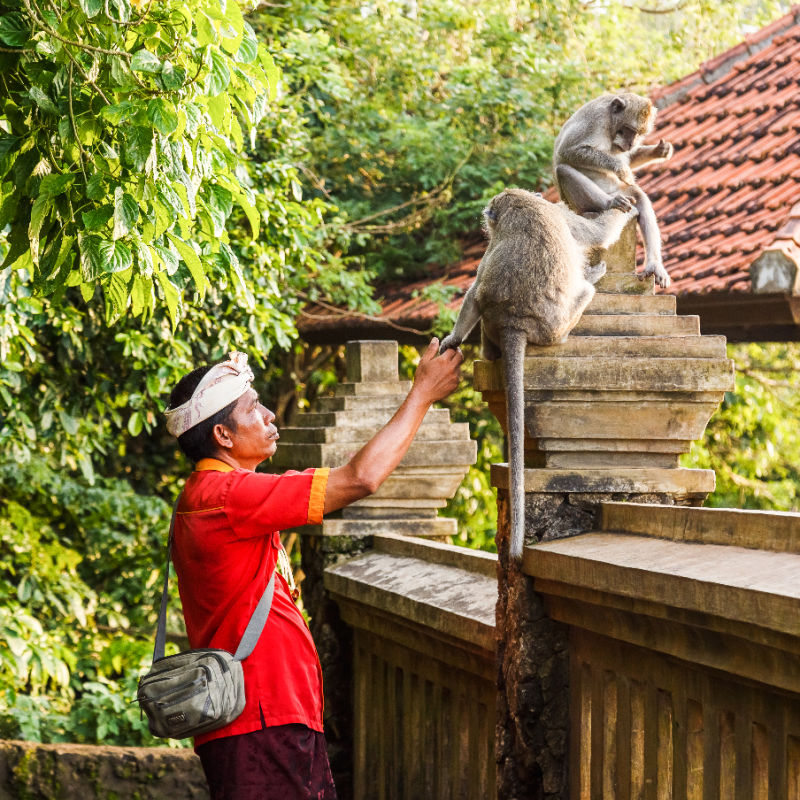

He explained that direct contact between monkeys and tourists is usually in the form of scratching to biting.
From the 20 cases throughout the year to September, most cases were superficial scratches; nonetheless, a full post-exposure anti-rabies protocol must be followed. If there is a serious case, such as a bite and especially if the bite occurs in the neck area upwards, then tourists are immediately rushed to the Rabies Center.
Pujawan told reporters, “Thankfully, we are supported by the Badung Regency Health Office. So, every guest who is scratched or bitten, we run to the nearest Rabies Center to get the Anti-Rabies Vaccine (VAR) or serum for free.”
It is the case at all of Bali’s major monkey forest and monkey temple attractions that it is forbidden to interact with the wild primates. Tourists are reminded that many visitors do not obey the rules either because they are not aware or actively choose to take the risk. Tourists should not follow the actions of other visitors who are breaking the rules; instead, alert a member of staff to ensure the safety and well-being of both the monkeys and other visitors.
For the latest Bali News & Debate Join our Facebook Community
Plan Your Bali Holiday:
Book The Best English Speaking Drivers For Airport Transfers & Tours
Discover more from The Bali Sun
Subscribe to get the latest posts sent to your email.
Anonymous
Tuesday 17th of February 2026
Whilst I really enjoyed visiting the monkey forest, and saw the signs not to touch the monkeys, there were no warning signs regarding the real risk of Rabies, and the signage contradicts the actions of entering the park, when you are given a paper bag of peanuts and water. My visit to the park was impromptu/ unplanned as my driver for the day suggested we went. I didn’t want too much monkey attention so hid the bag under my arm. Still the monkeys spotted it, and ripped it open from behind. Following that, a member of staff encouraged me to feed a monkey by placing a peanut on my hand that was taken. Without invitation, another monkey climbed to my shoulder and the staff member offered up a peanut. Whilst this was sweet and the monkey only 5 years old, when peeling the peanut, a fragment of the husk entered my eye, which scratched it. Having not seen how the monkey peeled its peanut and consulting with my driver, I thought nothing more of it until I did further research. As I was due to fly home the next morning to the UK, there was little I could do until home. I’m now waiting GP consultation regarding risk and whether PEP is required. Unsettling.
Steve bm
Wednesday 22nd of October 2025
What about signs for monkeys don't touch the humans.
Exp
Tuesday 21st of October 2025
"If guest is scratched or bitten, we run to the nearest Rabies Center to get the Anti-Rabies Vaccine (VAR) or serum for free."
Do they inform about the rabies risk and vaccine procedure required if scratches/bites before selling the tickets? Sounds like money is above safety for tourists oblivious to the risk they take in areas with monkeys.
Shorty
Monday 27th of October 2025
@Exp, You seem to want signs and warnings every where So signs of Kuta Beach... 'Beware of the e-coli it can give you the shits'